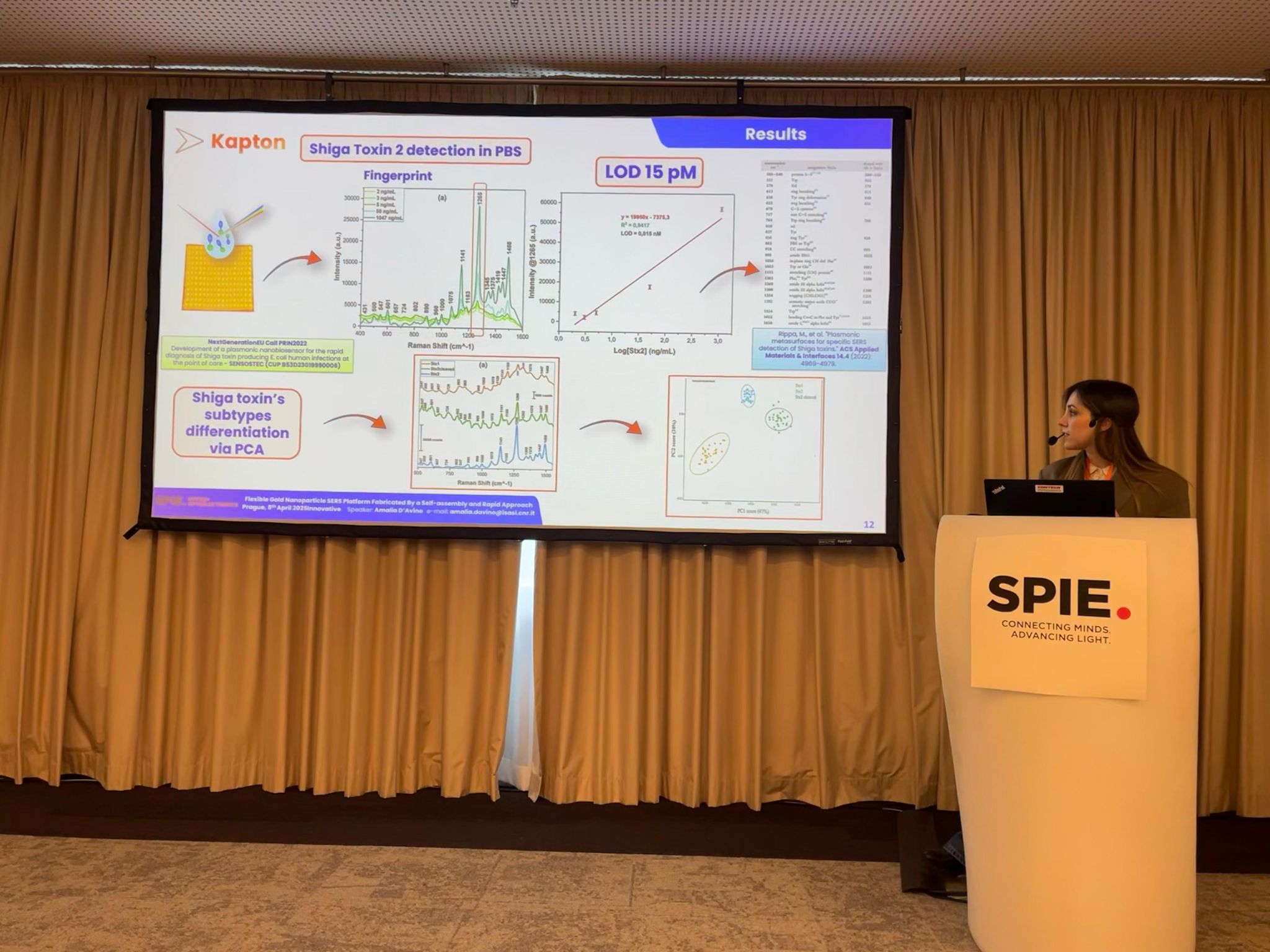
On Tuesday, April 8, during the SPIE Optics + Optoelectronics International Conference – Smart Materials for Opto-Electronic Applications 2025, held in Prague, Dr. Amalia D’Avino and Dr. Alessia Milano from the Institute of Applied Sciences and Intelligent Systems “E. Caianiello” of the CNR (ISASI-CNR) presented significant results from the NextGenerationEU-funded PRIN 2022 project titled: “Development of a plasmonic nanobiosensor for the rapid diagnosis of Shiga toxin producing E. coli human infections at the point of care – SENSOSTEC” (CUP B53D23019990006).
The project is coordinated by Dr. Lucia Petti, Senior Researcher at ISASI-CNR, in collaboration with Dr. Maurizio Brigotti from the Department of Medical and Surgical Sciences (DIMEC) of the University of Bologna, and Dr. Stefano Morabito, Director of the European Reference Laboratory for E. coli and Head of the Microbiological Food Safety and Food-Borne Diseases Unit, at the Department of Food Safety, Nutrition and Veterinary Public Health of the Istituto Superiore di Sanità (Italian National Institute of Health).
The primary goal of the project is to assess the performance of engineered plasmonic metastructures—fabricated via Electron Beam Lithography (EBL)—and self-assembled gold nanoparticle sensors, designed for both rigid and flexible substrates, when integrated into a nanobiosensor for the detection of Shiga toxins in biological samples (blood and stool). These biosensors will be used to develop a rapid diagnostic test that can be performed at the point of care (POC), enabling early diagnosis of STEC infections and timely supportive treatment. The system will also allow for the differential diagnosis of atypical hemolytic uremic syndrome (aHUS), which requires a distinct pharmacological approach.
No responses yet