
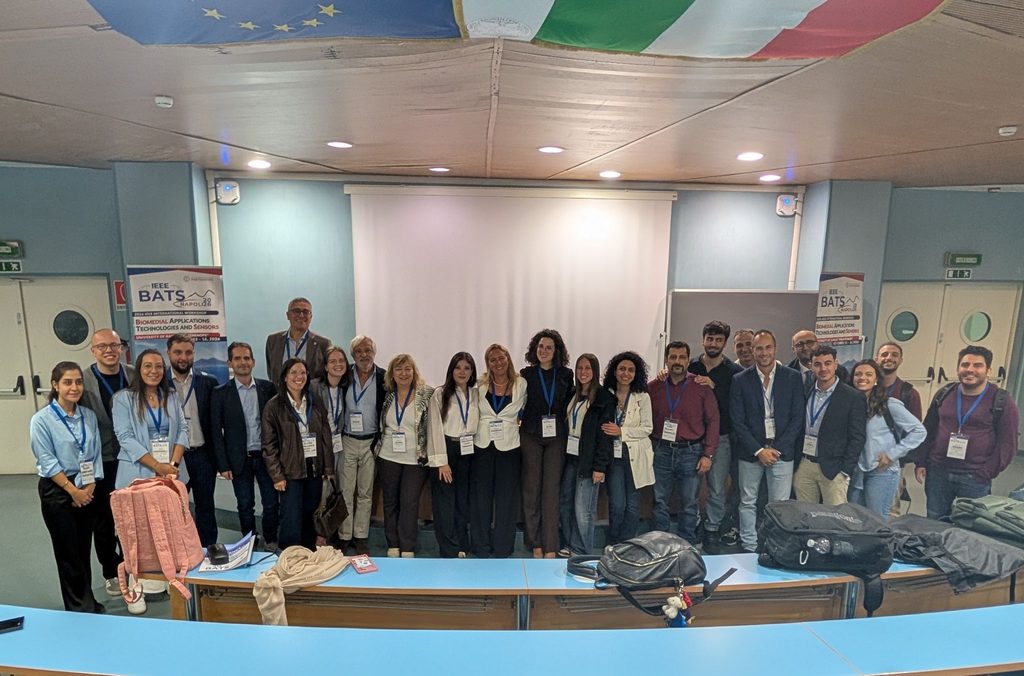
Naples, Italy — At the IEEE International Workshop on Biomedical Applications, Technologies and Sensors (BATS) held in Naples, NanoSmartLab postdoctoral researcher Dr. Alessia Milano delivered an invited talk highlighting our group’s latest advancements in plasmonic biosensing. Presenting research that bridges nanophotonics, clinical diagnostics, and food safety, Dr. Milano showcased how Surface-Enhanced Raman Scattering (SERS) is paving the way for rapid, point-of-care (PoC) detection of Shiga toxins.
The presented work, titled “Towards Point-of-Care and Food Safety Applications of SERS for Shiga Toxin Detection”, represents a multidisciplinary effort led by Dr. Lucia Petti alongside team members Alessia Milano, Amalia D’Avino, Valentina Marchesano, Domenico Sagnelli, Massimo Rippa, Bryan Guilcapi, and Lu Zhou. The research is carried out in close collaboration with Prof. Maurizio Brigotti (University of Bologna), Dr. Stefano Morabito (Istituto Superiore di Sanità), and Dr. Gianluigi Ardissino (Center for HUS Control, Prevention and Management, Ospedale Maggiore Policlinico, Milan).
The Diagnostic Challenge
Shiga toxin-producing Escherichia coli (STEC) infections pose a grave threat to human health, frequently causing severe hemorrhagic diarrhea and progressing to Hemolytic Uremic Syndrome (HUS)—a critical condition causing acute renal failure, predominantly in young children. Because Shiga toxins clear rapidly from blood serum within hours, early diagnosis is essential. However, conventional tools like ELISA, PCR, and Vero cell assays are hindered by long turnaround times, lack of subtyping capability, or inability to operate at the point of care.
NanoSmartLab’s Plasmonic Innovation
To overcome these diagnostic bottlenecks, NanoSmartLab developed a label-free SERS platform engineered for direct molecular fingerprinting of Shiga toxins:
Scalable Nanofabrication: Transitioning from electron-beam lithography (EBL) metasurfaces to benchtop Marangoni self-assembly of gold nanoparticles (AuNPs), achieving an enhancement factor of 3x 10^7 at low production cost.
Direct Serum Detection: Achieving a limit of detection (LOD) of 0.1 pM for Stx2 directly in human serum, eliminating the need for complex sample pre-processing or dilution.


Chemometric Subtyping via PCA: Applying Principal Component Analysis (PCA) to SERS spectra to discriminate between Stx1, Stx2, and clinically relevant cleaved Stx2 variants in a single measurement step.
Clinical Validation: Demonstrating first-in-class clinical validation on real pediatric HUS patient sera, correctly identifying Stx1 and Stx2 with zero false negatives.
Expanding to Food Safety: Adapting the self-assembled AuNP platform for rapid on-site screening of STEC in dairy matrices (such as cheese) in under 30 minutes.
Closing the Farm-to-Bedside Diagnostic Loop
By applying the same core plasmonic substrate across both agricultural supply chains and hospital settings, NanoSmartLab aims to establish an integrated diagnostic loop—linking food contamination sources directly to clinical outcomes.
This research is supported by the European Union through NextGenerationEU under the PRIN 2022 project SENSOSTEC (“Development of a plasmonic nanobiosensor for the rapid diagnosis of Shiga toxin producing E. coli human infections at the point of care”, CUP B53D23019990006).
Learn More
- Event Website: IEEE BATS Conference
- Lab Updates: NanoSmartLab News
No responses yet