The SERS-Cov project — “Advanced Nanobiosensing Platforms for Point-of-Care (POC) Diagnostics and Surveillance” — officially concluded on September 30th, marking a significant milestone in the development of innovative biosensing technologies.
Led by Dr. Lucia Petti (ISASI-CNR) and carried out in close collaboration with Dr. Giovanna Fusco, Director of the Virology Unit at the Experimental Zooprophylactic Institute of Southern Italy, the project was funded by the POR CAMPANIA FESR 2014–2020 program (CUP B53C22003100002).
This afternoon, some of the final outcomes of the project were presented by Dr. Amalia D’Avino during the European Researchers’ Night in Piazza del Gesù, Naples, highlighting the team’s latest advances in biophotonic and bioplasmonic technologies.
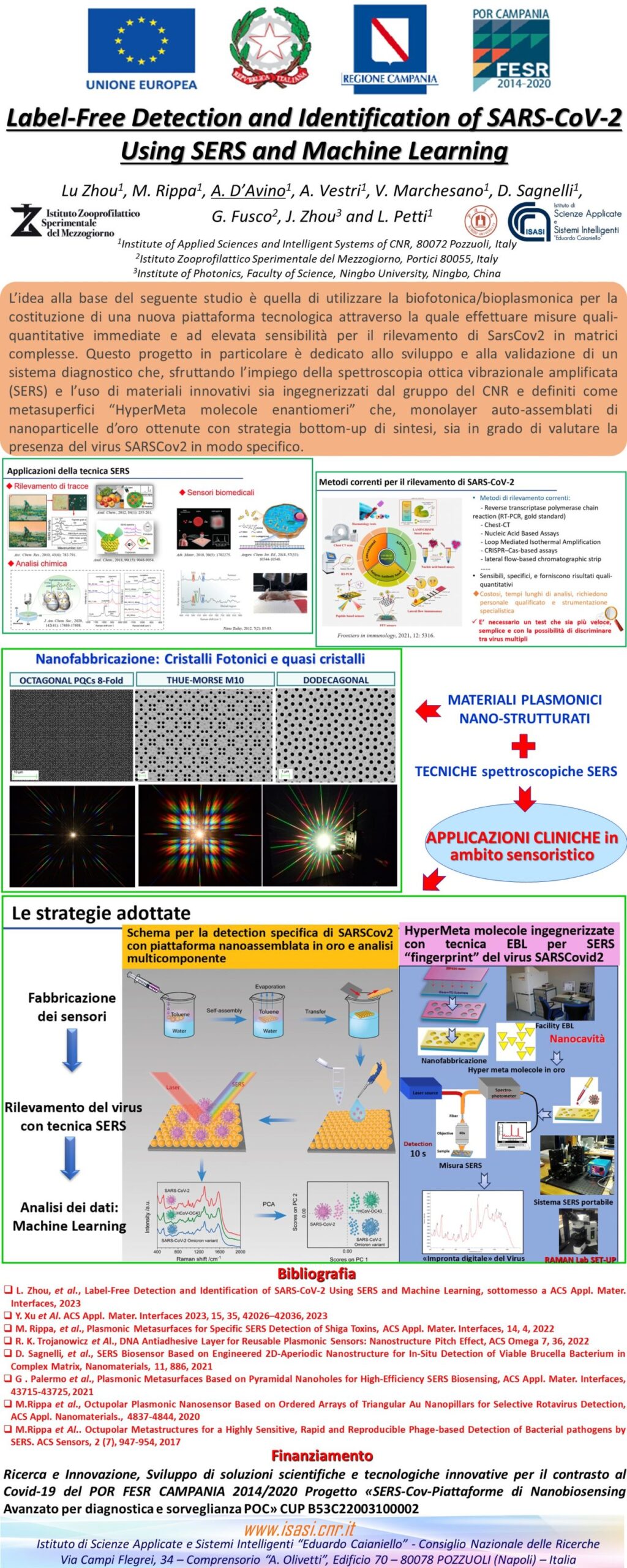
At the heart of this project is the ambition to create a rapid, reliable, and highly sensitive method for detecting SARS-CoV-2 in complex biological matrices. Two parallel nanofabrication approaches were developed to build cutting-edge nano-structured recognition systems:
- Top-down engineered metasurfaces, called HyperMeta molecules, fabricated using electron beam lithography.
- Bottom-up strategies using self-assembled monolayers of gold nanoparticles.
Both platforms were designed to detect the virus with high specificity and efficiency, advancing the frontier of Surface-Enhanced Raman Scattering (SERS) biosensing.
The team’s most recent results have been submitted to the special issue “High-Efficiency Surface-Enhanced Raman Scattering Biosensing” in the journal Biosensors, showcasing the potential of these nanotechnologies for real-world diagnostic applications.
This project exemplifies how multidisciplinary research — combining physics, engineering, virology, and nanotechnology — can produce practical tools for global health challenges. -B.G-
No responses yet